At Compassionate Navigation, we believe communication is more than a skill, it’s a lifeline.
It’s the difference between conflict and collaboration, between misunderstanding and momentum, between systems that struggle and systems that thrive. Every conversation has the power to build trust or break it. To open doors or close them. To strengthen relationships or strain them.
That’s why the BRIDGE Framework is at the core of everything we do. BRIDGE isn’t just a training topic. It’s our philosophy. Our method.
Our blueprint for helping people and organizations communicate with clarity, compassion, and confidence.
The B.R.I.D.G.E: The Heart of Compassionate Navigation

Where Communication Becomes Clarity, Connection, and Change
Why BRIDGE? Because Communication Is Where Everything Breaks Down… and Everything Breaks Open
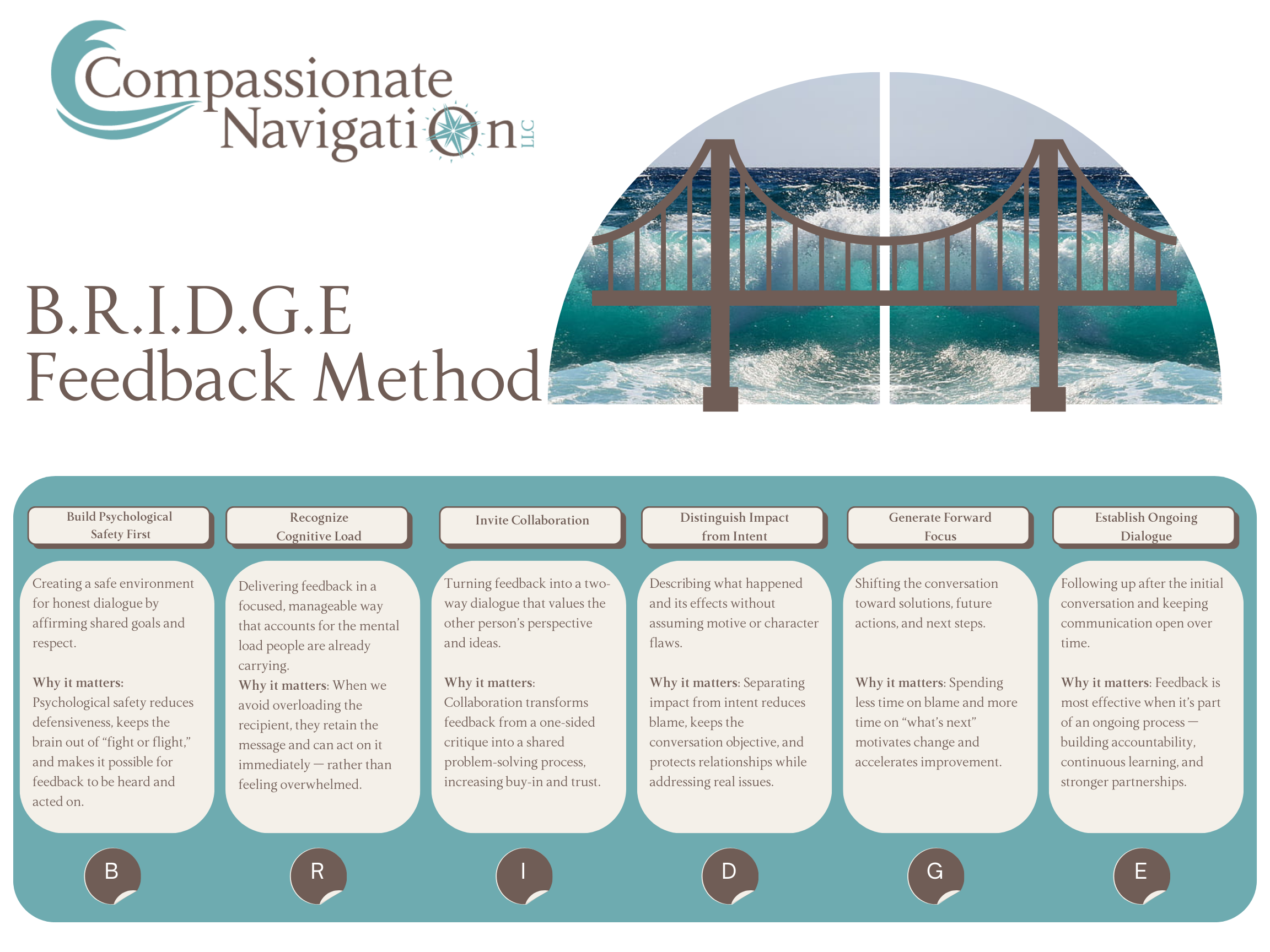
What is the BRIDGE Framework?
BRIDGE is a neuroscience-informed communication method built on decades of research in psychological safety, interpersonal neurobiology, conflict resolution, and organizational communication.
Each step is intentional. Each step is teachable. Each step moves people out of defensiveness and into dialogue.
B — Build Psychological Safety: People don’t hear feedback when they feel threatened.
They hear it when they feel valued, seen, and respected.
R — Recognize Cognitive Load: Under stress, the brain can’t process complex messages.
Cognitive load shrinks, so communication must, too.
I — Invite Collaboration: Curiosity dissolves resistance.
Collaboration turns “my way” vs. “your way” into “our way.”
D — Distinguish Impact from Intent: Most conflicts escalate because people argue about motives. BRIDGE shifts the conversation to outcomes and solutions.
G — Generate Forward Focus: Blame looks backward.
Progress looks forward.
E — Establish Ongoing Dialogue: Change doesn’t happen in one conversation.
It happens in conversations that continue.
Most communication problems don’t start with what people say.
They start with:
Stress that shuts down listening
Fear that triggers defensiveness
Hierarchy that erodes psychological safety
Cognitive overload that leads to withdrawal
Assumptions about intent that accelerate conflict
Lack of shared language for giving feedback
You’ve seen conversations spiral not because people are “difficult,” but because they’re overwhelmed, unheard, or unprepared.
BRIDGE was created to solve this. It names the invisible forces beneath communication and gives people a clear, repeatable process for handling them.
Why BRIDGE? Because It Works
How BRIDGE Shapes Every Service We Offer
Conflict Mediation & Difficult Conversations Coaching
We don’t just resolve conflict, we help you understand it.
BRIDGE guides every step, from setting safety to shifting from tension to collaboration.
Team Training and Workshops
Whether your team struggles with internal communication, customer interactions, or feedback, BRIDGE provides a shared language and a practical toolkit.
Organizational Culture and Communication Consulting
Healthy cultures aren’t built through policies; they’re built through communication.
BRIDGE informs how organizations build psychological safety, handle feedback, and communicate during change.
Clinical and Patient Communication Training
In healthcare and advocacy settings, conversations can affect outcomes.
BRIDGE equips professionals to navigate resistance, fear, and high-stress interactions.
Keynotes and Leadership Development
Leadership isn’t about talking more; it’s about communicating with intention.
BRIDGE helps leaders influence without escalating, correct without shaming, and inspire without overpowering.
Organizations report:
✓ Reduced turnover
✓ Improved collaboration across departments
✓ Higher client satisfaction
✓ Stronger trust in leadership
✓ Better outcomes, whether clinical, operational, or interpersonal
Teams report:
✓ Less conflict
✓ More confidence in tough conversations
✓ Stronger relationships with clients and colleagues
✓ Faster conflict recovery
✓ Fewer communication breakdowns
✓ Higher engagement and morale
BRIDGE isn’t a one-time strategy; it becomes a habit. A shared language.
A way of working that strengthens every relationship.
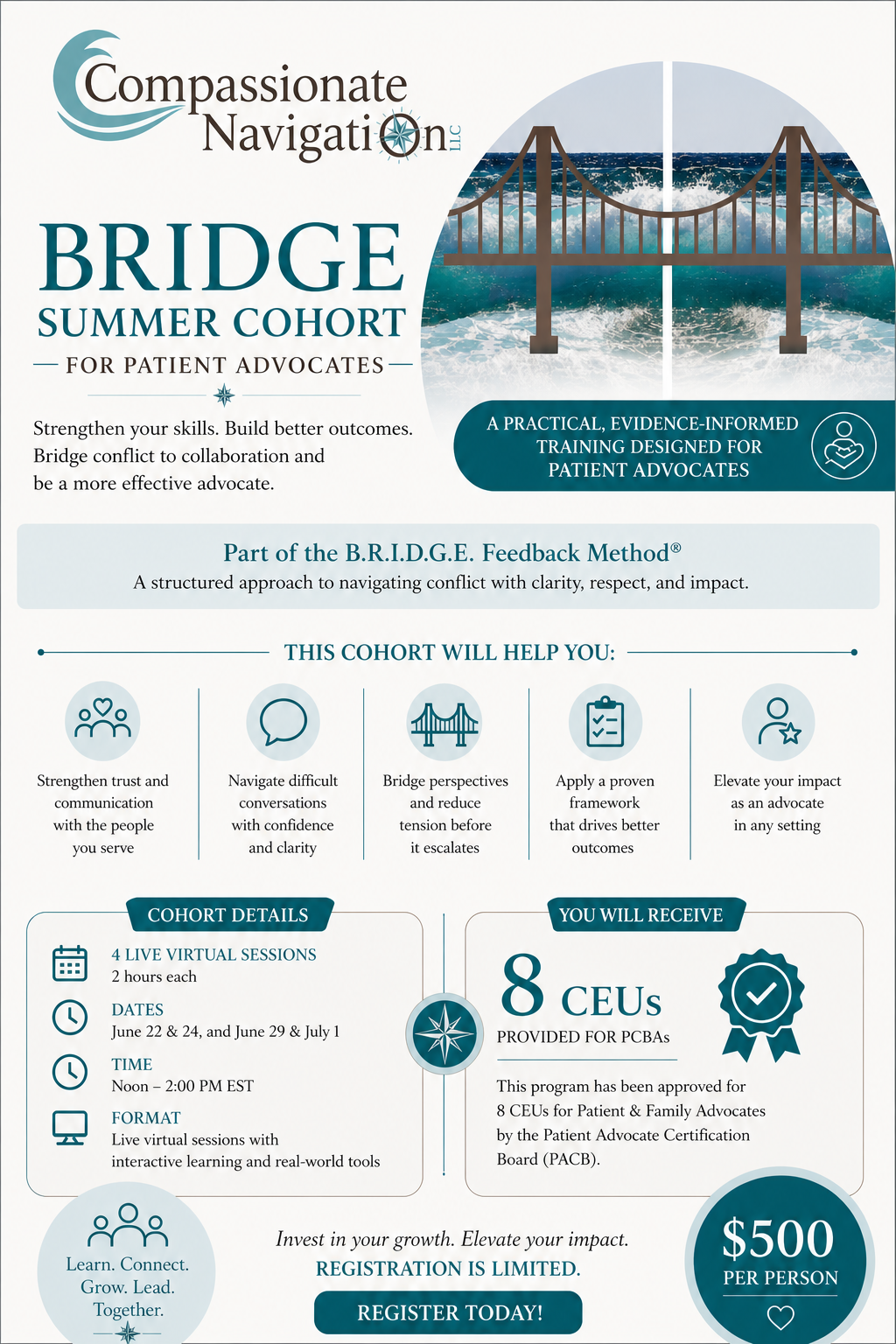
BRIDGE Certificate Program
Structured conversations for safer care, stronger teams, and better outcomes.
The BRIDGE Certificate equips professionals with a practical, evidence-informed communication framework for navigating feedback, conflict, emotionally charged conversations, and moments of misunderstanding with clarity and compassion.
Why BRIDGE Matters
Difficult conversations are not just interpersonal moments. They shape trust, retention, patient experience, team morale, and organizational safety. BRIDGE gives professionals a repeatable structure for staying grounded, reducing defensiveness, and moving conversations toward clarity and repair.
Who It’s For
This certificate is designed for:
Patient advocates
Healthcare professionals
Social workers and care coordinators
Supervisors and team leaders
Mediators and conflict resolution professionals
Higher education and nonprofit professionals
What You’ll Learn
Participants will learn how to:
Build psychological safety before difficult conversations
Recognize cognitive load and emotional escalation
Invite collaboration instead of defensiveness
Distinguish impact from intent
Generate forward-focused solutions
Establish ongoing dialogue after rupture or conflict
What’s Included
Live instruction
BRIDGE workbook
Case studies and reflection tools
Practice scenarios
Certificate of completion
Optional organizational implementation support