


Stay STEADY When Emotions Run High
When people feel threatened, overwhelmed, or emotionally activated, communication changes.
Conversations become reactive. Assumptions replace curiosity. Problem-solving shuts down.
The STEADY Framework helps individuals and organizations respond differently, using practical communication strategies grounded in neuroscience, trauma-informed practice, and conflict resolution.
Whether you're supporting patients, employees, students, clients, or family members, STEADY provides a clear path for responding with confidence, compassion, and calm.
Because calmer conversations lead to better outcomes.
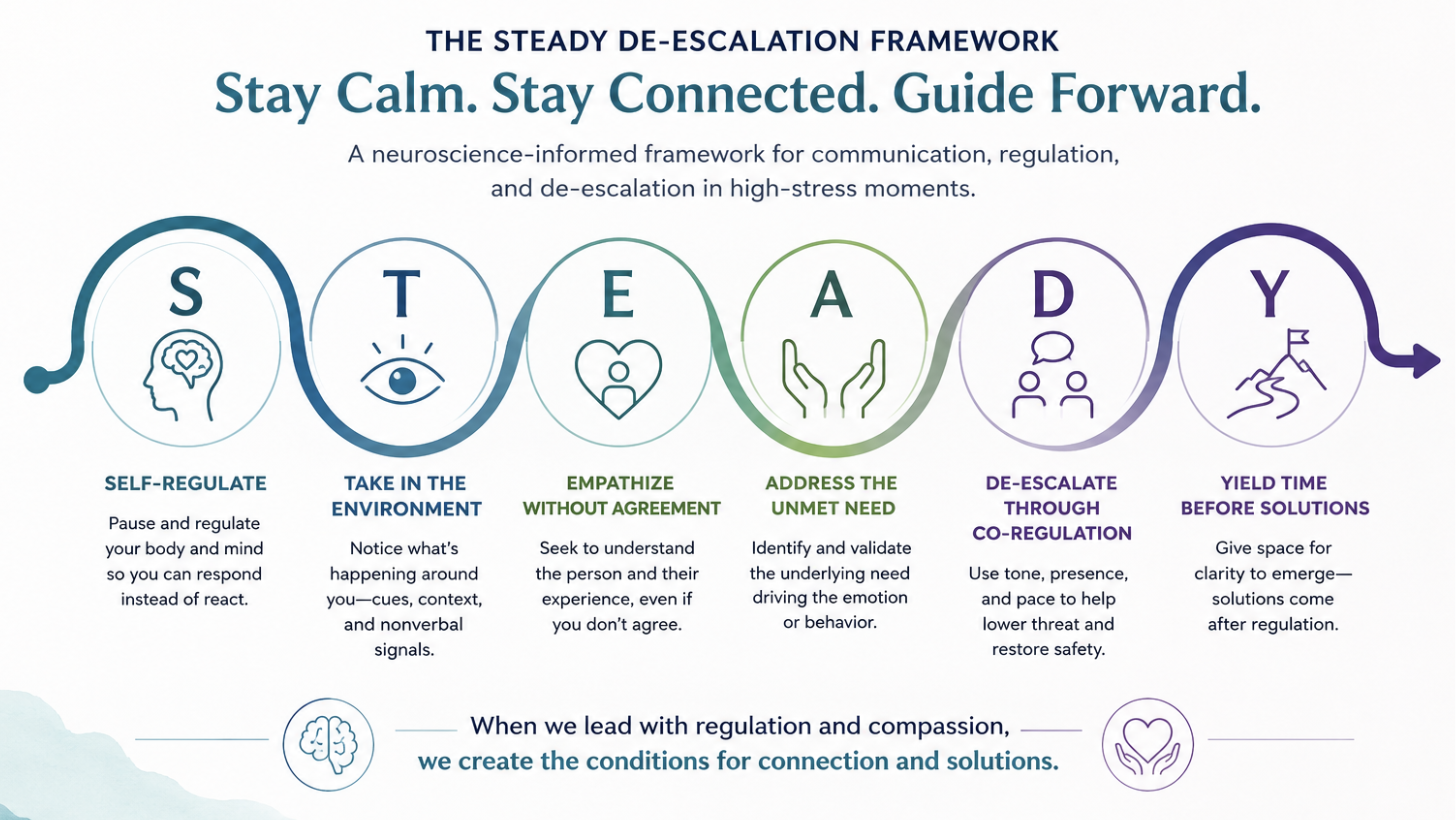
STEADY Helps You...
✓ Stay calm when emotions rise
✓ Reduce defensiveness
✓ Recognize nervous system activation
✓ Build trust during difficult conversations
✓ Respond instead of react
✓ Create conditions for collaborative problem-solving
What is STEADY?
STEADY is Regulation Before Resolution
Many communication models focus on solving the problem. STEADY recognizes that people often cannot solve the problem until their nervous system feels safe enough to engage.
Rather than reacting to emotion, STEADY helps you understand it, regulate it, and guide conversations toward productive outcomes.
The result isn't simply de-escalation. It's healthier communication under pressure.
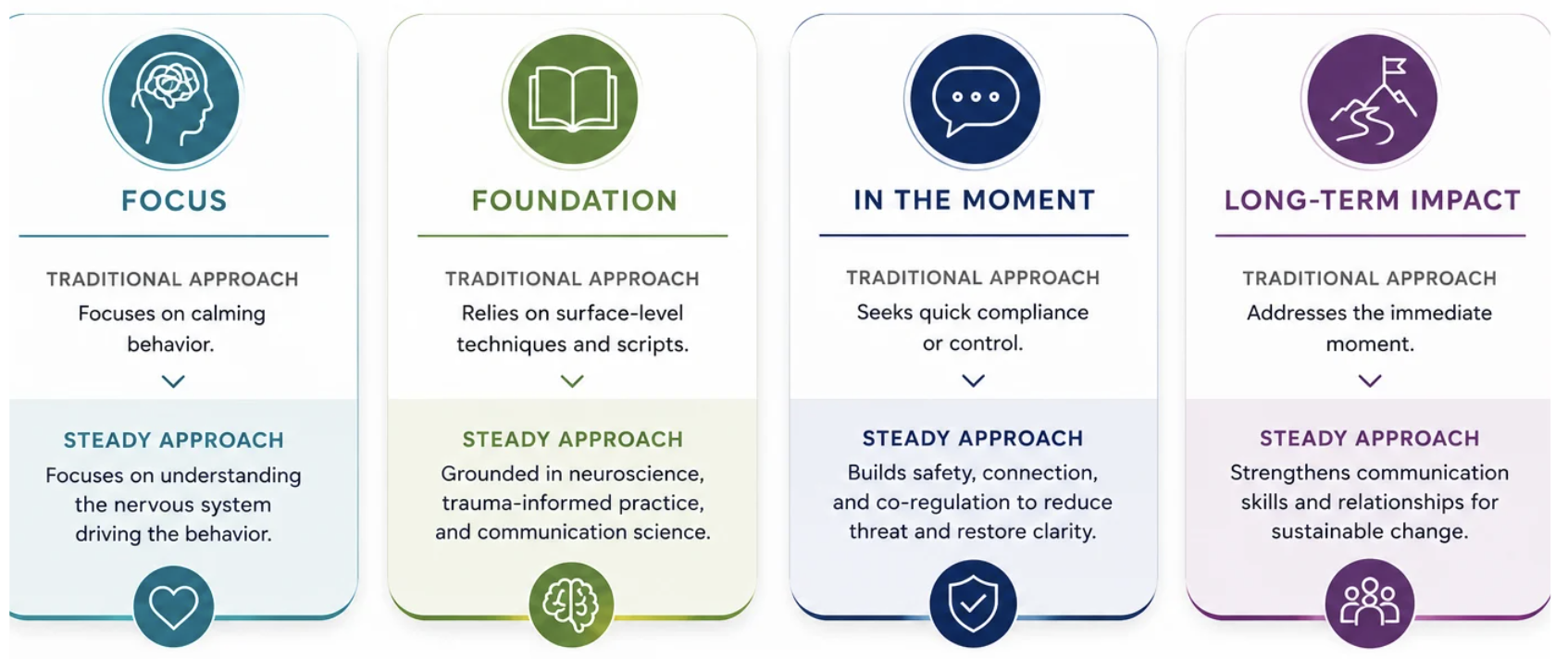
What makes Steady different?
STEADY in Action
Real-world moments where regulation changes the conversation.
Every difficult conversation looks different. The common thread is that emotions have taken over, making productive communication difficult. STEADY provides a practical path for responding with calm, clarity, and connection.
Healthcare
A frustrated family member at the nurses' station
A patient's daughter is upset after waiting hours for an update. Her voice is rising, staff members are becoming defensive, and everyone feels the tension.
Instead of trying to "calm her down," the nurse uses STEADY to regulate their own response, acknowledge the uncertainty the family is experiencing, and create enough psychological safety for a productive conversation. The interaction shifts from confrontation to collaboration.
Outcome: Reduced escalation, improved trust, and clearer communication.
Families & Caregiving
A difficult conversation about an aging parent
Adult siblings disagree about caregiving responsibilities. Years of family history begin resurfacing, and the conversation stalls.
Rather than debating who is right, STEADY helps family members recognize the emotions underneath the disagreement, slow the conversation, and focus on the shared goal of supporting their loved one.
Outcome: Better communication and more collaborative decision-making.
Human Resources
An employee receives difficult feedback
A supervisor begins a performance conversation, and the employee immediately becomes defensive, interrupting and explaining why none of the concerns are fair.
Rather than pushing harder, the manager recognizes the signs of cognitive overload and emotional activation. Using STEADY, they slow the pace, reduce perceived threat, and create space for the employee to engage instead of defend.
Outcome: A conversation focused on growth instead of blame.
Community & Public Health
A resident challenges a public health recommendation
A community member arrives angry and distrustful, convinced they are not being heard.
Instead of immediately correcting misinformation, the public health professional uses STEADY to reduce defensiveness, acknowledge concerns, and build enough trust for meaningful dialogue.
Outcome: Increased engagement and a greater willingness to continue the conversation.
When STEADY Leads...
✔ Threat decreases.
✔ Trust begins to rebuild.
✔ People regain the ability to think clearly.
✔ Better solutions become possible.
Who Benefits from STEADY?
Healthcare
Navigate emotionally charged conversations with patients, families, and care teams while reducing escalation and strengthening trust.
Human Resources
Support managers and employees through difficult conversations, workplace conflict, and organizational change.
Education
Help educators, administrators, and families communicate more effectively during challenging situations.
Public Health & Human Services
Build trust with communities, reduce resistance, and strengthen relationships during high-stress interactions.
Leadership
Lead with confidence during uncertainty, organizational change, and emotionally complex decisions.
Community Organizations & Nonprofits
Strengthen communication among staff, volunteers, boards, and community members.



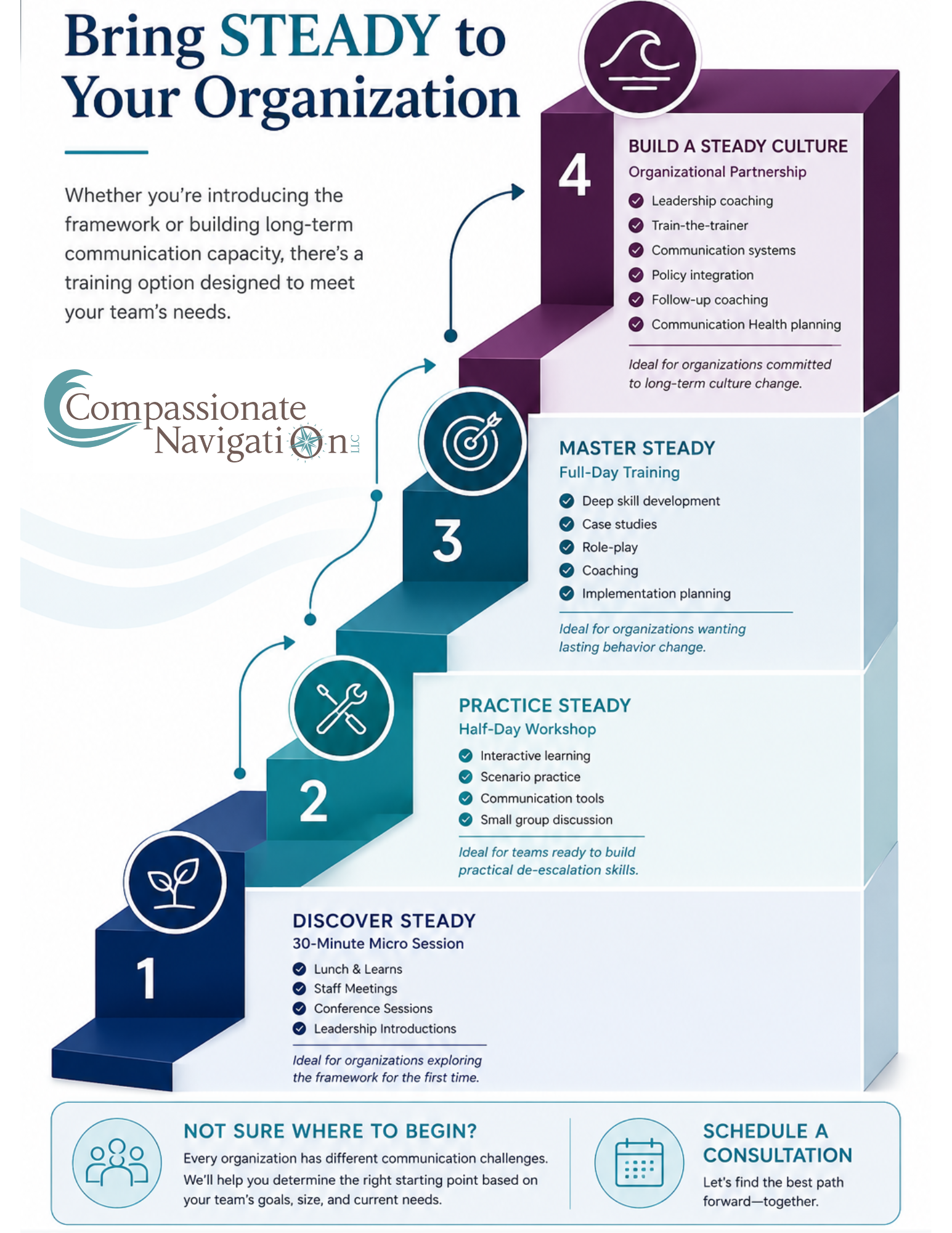
Learn STEADY Your Way
Whether you're introducing STEADY during a staff meeting or building a long-term communication strategy across your organization, we offer flexible training options that meet your team where they are and grow with you over time.
-
Most organizations begin with a 30-minute micro session or half-day workshop. If your team is facing active conflict or repeated escalation, we may recommend a consultation first.
-
Yes. Examples and practice scenarios can be tailored for healthcare, HR, education, public health, human services, leadership, or community-facing work.
-
Yes, but it goes deeper. STEADY focuses on regulation, threat reduction, communication patterns, and co-regulation, not just behavior management.
-
Yes. Training options are priced based on length, customization, audience size, and level of support. Community partner pricing may be available for nonprofit organizations.
Introductory sessions begin at $750. Half-day, full-day, and organizational partnership pricing available by proposal.
-
Yes. STEADY helps people respond when emotions are high. BRIDGE helps people give feedback, repair trust, and move forward after difficult conversations.
-
Yes. STEADY can be offered virtually or in person, depending on your team’s needs.
Frequently Asked Questions
STEADY isn't about controlling behavior.
It's about understanding behavior. It recognizes that people communicate differently when they're overwhelmed, threatened, grieving, burned out, or emotionally activated.
Rather than teaching scripts to memorize, STEADY teaches principles people can adapt to real conversations—whether they're speaking with a patient, employee, student, customer, or family member.
That's why organizations use STEADY not only to de-escalate conflict, but to build healthier communication cultures over time.
Communication Under Pressure Is a Skill.
No one is born knowing how to navigate emotionally charged conversations.
These skills can be learned.
They can be practiced.
And they can transform the way individuals, teams, and organizations respond when the stakes are highest.
When people feel safe, respected, and understood, better conversations become possible.
And better conversations change everything.
Ready to bring STEADY to your team?