

A Communication Framework for Building Trust Before, During, and After Difficult Conversations
Communication doesn't fail because people don't care.
It often fails because stress, assumptions, cognitive overload, and defensiveness make it difficult to hear one another.
BRIDGE provides a practical, evidence-informed framework that helps people communicate with greater clarity, curiosity, and compassion, especially when the stakes are high.

Where Communication Becomes Clarity, Connection, and Change
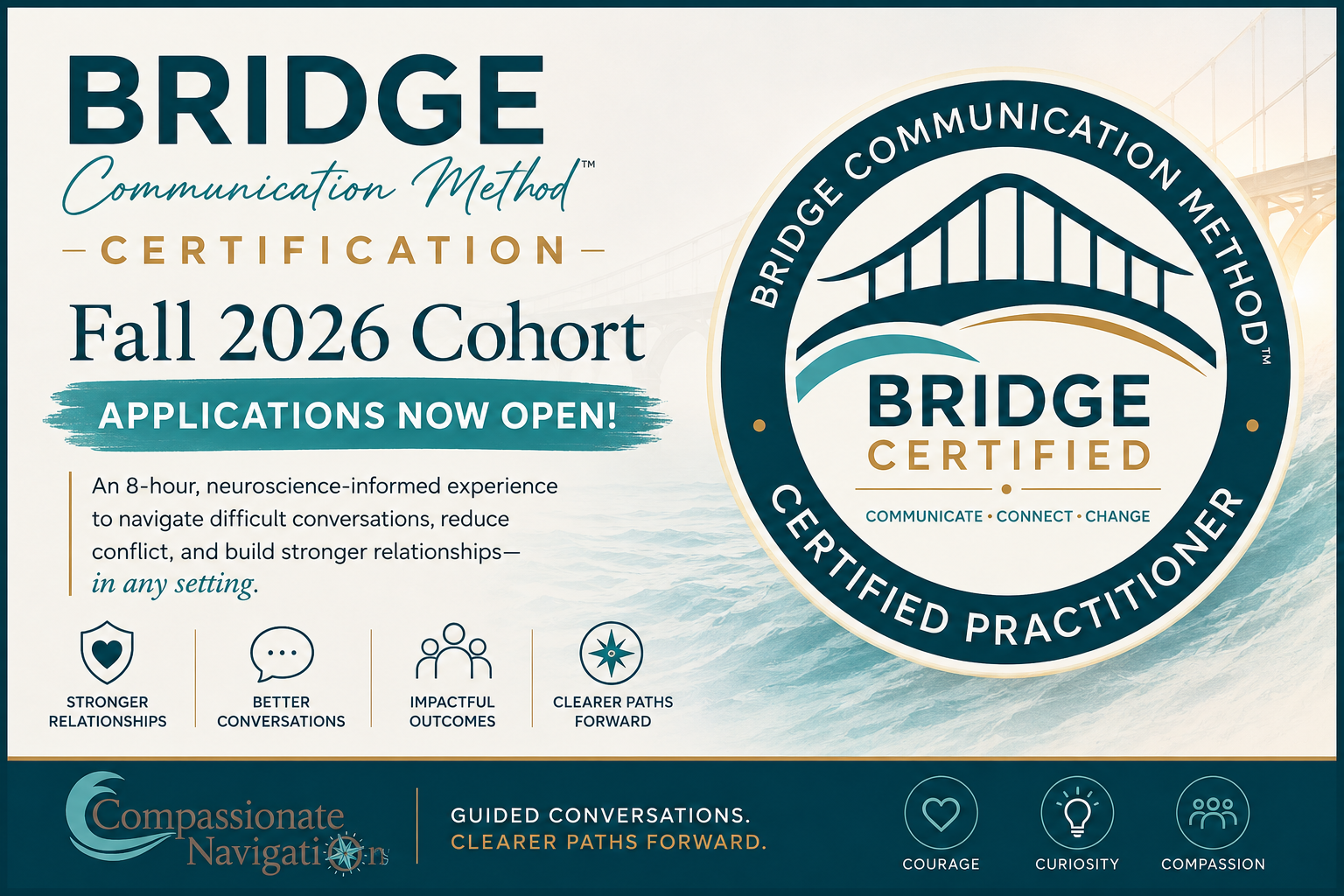
BRIDGE Communication Method™ Certification
A practical framework for difficult conversations, stronger relationships, and better outcomes.
The BRIDGE Communication Method™ Certification equips professionals with a practical, evidence-informed communication framework for navigating feedback, conflict, emotionally charged conversations, and moments of misunderstanding with clarity and compassion.
Why BRIDGE Matters
Difficult conversations are not just interpersonal moments. They shape trust, retention, patient experience, team morale, and organizational safety. BRIDGE gives professionals a repeatable structure for staying grounded, reducing defensiveness, and moving conversations toward clarity and repair.
Who It’s For
This certificate is designed for:
Patient advocates
Healthcare professionals
Social workers and care coordinators
Supervisors and team leaders
Mediators and conflict resolution professionals
Higher education and nonprofit professionals
What You’ll Learn
Participants will learn how to:
Build psychological safety before difficult conversations
Recognize cognitive load and emotional escalation
Invite collaboration instead of defensiveness
Distinguish impact from intent
Generate forward-focused solutions
Establish ongoing dialogue after rupture or conflict
What’s Included
Live instruction
BRIDGE workbook
Case studies and reflection tools
Practice scenarios
Certificate of completion
Optional organizational implementation support
Why BRIDGE? Because Communication Is Where Everything Breaks Down… and Everything Breaks Open
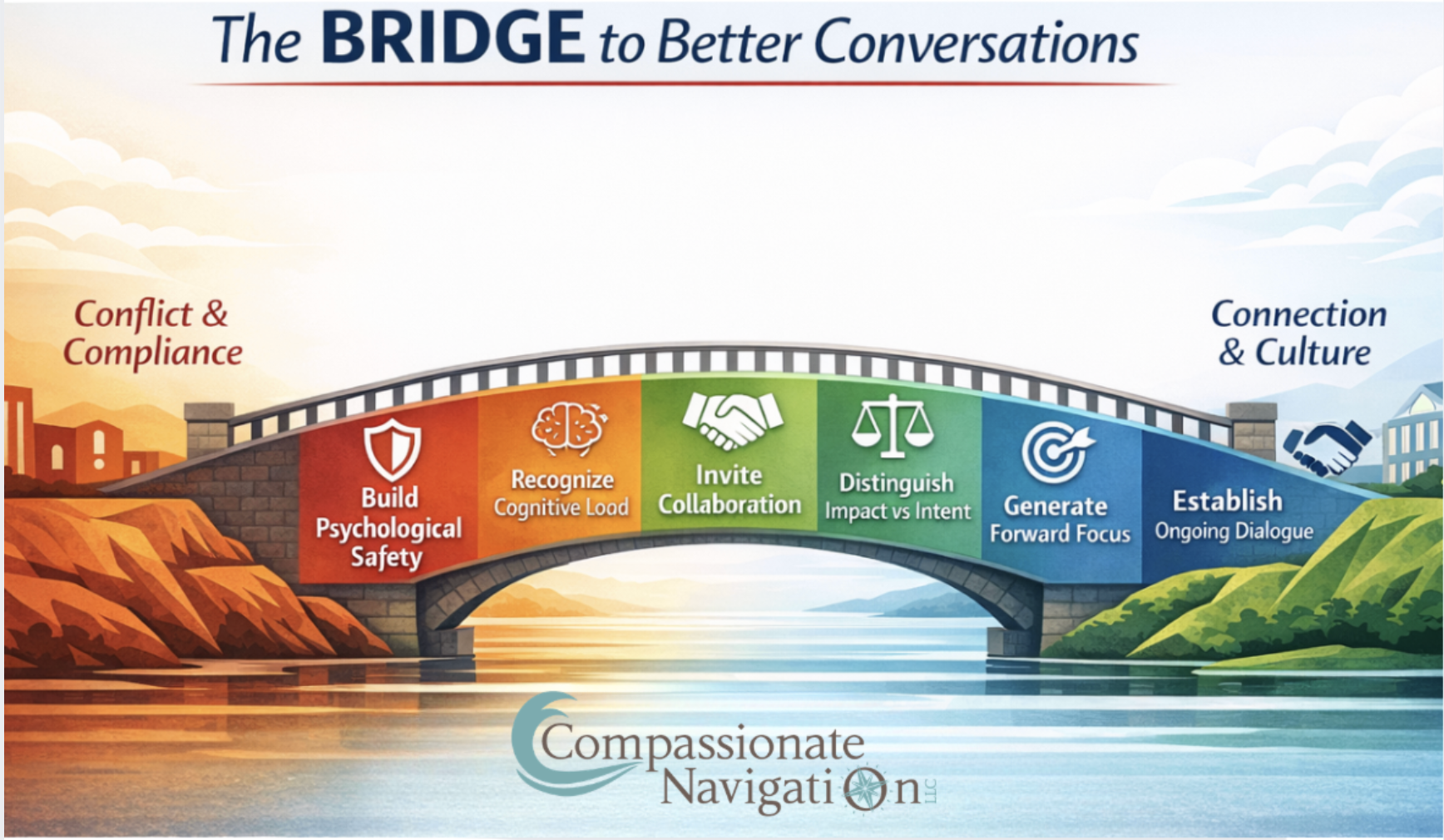
What is the BRIDGE Communication Framework?
BRIDGE is a neuroscience-informed communication method built on decades of research in psychological safety, interpersonal neurobiology, conflict resolution, and organizational communication.
Each step is intentional. Each step is teachable. Each step moves people out of defensiveness and into dialogue.
B — Build Psychological Safety: People don’t hear feedback when they feel threatened.
They hear it when they feel valued, seen, and respected.
R — Recognize Cognitive Load: Under stress, the brain can’t process complex messages.
Cognitive load shrinks, so communication must, too.
I — Invite Collaboration: Curiosity dissolves resistance.
Collaboration turns “my way” vs. “your way” into “our way.”
D — Distinguish Impact from Intent: Most conflicts escalate because people argue about motives. BRIDGE shifts the conversation to outcomes and solutions.
G — Generate Forward Focus: Blame looks backward.
Progress looks forward.
E — Establish Ongoing Dialogue: Change doesn’t happen in one conversation.
It happens in conversations that continue.
Most communication problems don’t start with what people say.
They start with:
Stress that shuts down listening
Fear that triggers defensiveness
Hierarchy that erodes psychological safety
Cognitive overload that leads to withdrawal
Assumptions about intent that accelerate conflict
Lack of shared language for giving feedback
You’ve seen conversations spiral not because people are “difficult,” but because they’re overwhelmed, unheard, or unprepared.
BRIDGE was created to solve this. It names the invisible forces beneath communication and gives people a clear, repeatable process for handling them.
Why BRIDGE? Because It Works
BRIDGE in Action: One framework. Countless conversations.
The examples below are inspired by real engagements and reflect the types of conversations we support. To protect privacy and confidentiality, identifying details have been changed or combined.
Healthcare: Helping families make difficult decisions together.
A family struggling to make decisions about a loved one's care found themselves talking past one another rather than working together. By slowing the conversation, recognizing emotional overload, and creating space for every voice, they were able to move from frustration toward shared understanding and a plan everyone could support.
BRIDGE Focus: Build • Recognize • Invite
Workplace Leadership: Turning feedback into collaboration.
A supervisor needed to address ongoing performance concerns but wanted to preserve the employee's confidence and engagement. Using BRIDGE shifted the conversation from blame to curiosity, creating a productive discussion that led to clear expectations and renewed trust.
BRIDGE Focus: Build • Distinguish • Generate
Mediation: Finding common ground after conflict.
Two colleagues had reached a point where communication had broken down completely. Rather than focusing on who was right, BRIDGE helped them explore impact, clarify intentions, and identify shared goals for moving forward.
BRIDGE Focus: Invite • Distinguish • Establish
Relationships: Changing the conversation, not just the outcome.
A couple found themselves having the same argument over and over again. Through a structured conversation, they began to recognize the underlying needs driving the conflict. While they didn't solve every issue in one session, they left with a deeper understanding of one another and a healthier way to approach future disagreements.
BRIDGE Focus: Recognize • Invite • Generate
Higher Education: Building psychological safety in the classroom and on campus.
Faculty and staff learned practical communication strategies that encouraged respectful dialogue, reduced defensiveness, and created environments where students and colleagues felt more comfortable asking questions, sharing concerns, and working through disagreement.
BRIDGE Focus: Build • Invite • Establish
Community & Public Health: Strengthening conversations that build trust.
Community organizations and public health professionals often engage with people experiencing stress, uncertainty, or skepticism. BRIDGE helps professionals communicate with empathy while maintaining clarity, increasing trust, and supporting more collaborative relationships.
BRIDGE Focus: Build • Recognize • Generate
Organizations report:
✓ Reduced turnover
✓ Improved collaboration across departments
✓ Higher client satisfaction
✓ Stronger trust in leadership
✓ Better outcomes, whether clinical, operational, or interpersonal
Teams report:
✓ Less conflict
✓ More confidence in tough conversations
✓ Stronger relationships with clients and colleagues
✓ Faster conflict recovery
✓ Fewer communication breakdowns
✓ Higher engagement and morale
BRIDGE isn’t a one-time strategy; it becomes a habit. A shared language.
A way of working that strengthens every relationship.
Now Accepting Applications for the Fall 2026 Cohort
Become a BRIDGE Certified Practitioner
Difficult conversations are part of every workplace, organization, and community. Yet most professionals are expected to navigate them without ever being given a clear framework for how to do it well.
The BRIDGE Communication Method™ Certification is an immersive, 8-hour learning experience for professionals who want to communicate more effectively when conversations are complex, emotions are high, or relationships matter.
Through a neuroscience-informed, relationship-centered framework, you will learn to reduce defensiveness, build trust, strengthen collaboration, and help difficult conversations move forward.
The Fall 2026 cohort is intentionally small and open to professionals across industries and settings.
Fall 2026 Cohort
Format: Virtual, interactive training
Length: 8 hours
Dates: October (Days and times TBD; based on the group's needs).
Cohort: Small-group learning experience. Space will be limited to 25 people.
Who can apply: Professionals across industries and settings
Investment
Early Bird Rate: $500 (apply by September 18, 2026)
Standard Tuition: $650 (after September 18, 2026)
Group Discounts: Available for organizations registering three or more participants.
APPLY BELOW FOR THE FALL 2026 COHORT
This short application helps us learn about your work, the conversations you navigate, and what you hope to gain from the experience.
Want to Learn BRIDGE With Your Team?
Organizations can schedule a private BRIDGE Certification cohort for leaders, staff, departments, or cross-functional teams.
Private cohorts allow your team to learn a shared communication framework together and apply BRIDGE to the real challenges, conversations, and dynamics within your organization.